

Dr Stephanie Norwood sums up her key takeaways from the recent EngBio Forum on Sustainable Bioproduction.
On Wednesday 7th May, the EngBio IRC and Climate SynBio Society hosted our EngBio Forum. We were delighted to welcome keynote speakers Prof Irina Borodina and Prof Louise Horsfall. The fantastic talks met with an enthusiastic audience. There was a lively Q&A, with discussions continuing well into the evening reception.
As always, the talks and science were fascinating! Both speakers also shared some great advice on how we can harness biology to tackle the climate crisis. So, how do we build a more sustainable bioeconomy? Here are a few of my key take-aways from the evening’s talks.
1. Address problems before they become crises
Both speakers started by highlighting the need to think ahead. Prof Borodina shared the "Planetary Boundaries" framework developed by the Stockholm Resilience Centre. The framework outlines nine boundaries that should not be crossed. Agriculture is a major contributor to crossing these boundaries. Irina’s work began with using bioproduction to improve environmental impact in this area. She shared three stories of how her lab and companies are using yeast for sustainable agriculture: 1) developing environmentally-friendly pesticides, 2) producing natural food colourings, and 3) making a yeast-based meat alternative.
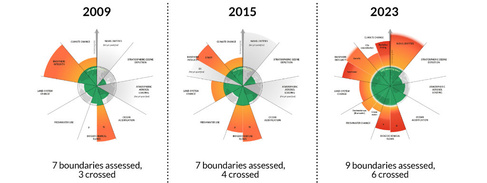
The evolution of the planetary boundaries framework. The framework assesses nine boundaries and shows how an increasing number of boundaries have been crossed between 2009 and 2023.
Prof Horsfall started by highlighting the urgency of the climate crisis and the need for a circular economy. Louise's work uses bacteria to recycle metals, including from lithium-ion batteries. As more cars become electric, there is a growing demand for lithium-ion batteries. As these batteries wear out, we will produce an increasing amount of metal waste. Unfortunately, we currently have no effective way to recycle this waste. Exploring how to address such problems before they become unmanageable is essential.
2. Find the right problem
Both speakers spoke about how to effectively identify the ‘right’ problem. Prof Borodina discussed the importance of talking to people living and working in the areas affected. The idea for her natural pesticide start-up came from a discussion with someone in the integrated pest management business. Their pheromone-based solutions were used primarily for organic fruits and vegetables, but the cost was too high to enter the row crop market. By learning about the problems faced in the industry, Irina’s team was able to find an effective solution. Meanwhile, Prof Horsfall shared that her project grew from attending a workshop outside her area of expertise. By exploring a new area she was able to provide a different perspective, and find an alternative solution to the problem.
3. Think creatively and always keep sustainability in mind
The work of both scientists required creative thinking and problem-solving. This was the most lasting impression I took from the talks. Firstly, both pushed the boundaries with their use of innovative bio-based methods. This had opened up new possibilities in their respective fields. Then, as their projects developed, creative-thinking had allowed them explore new paths. For example, Irina’s use of a non-model yeast - Yarrowia lipolytica - and Louise’s experiments with lab waste.
Both also discussed how they had integrated Life Cycle Assessment early in their research. Life Cycle Assessment, or LCA, is a method for assessing the environmental impact of a product. LCA allowed the researchers to compare their new methods to current practices. This way they could ensure that their solutions offered a more sustainable option.
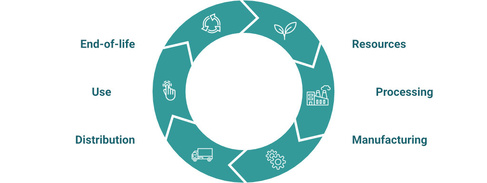
Life Cycle Assessment. The scheme shows a typical life cycle assessment which analyses the environmental impact of a product or service throughout it’s life. Assessment areas include resources, processing, manufacturing, distribution, use and end-of-life.
4. Work interdisciplinarily
Interdisciplinary work is key to modern scientific research. Both speakers stressed the importance of working collaboratively with experts in different areas. Irina highlighted how her companies employ diverse teams, with experts in different areas. Similarly, Louise discussed how her collaborations with electrochemists were essential for her work.
5. Engage with the public
The session rounded up with a Q&A, including an insightful question on how we should communicate this work to the public. Prof Borodina discussed the importance of clear communication and education. Prof Horsfall added that we need ongoing discussions and dialogue with the public. Engaging the public will ensure that research in the area is able to make a sustained impact.
More Information
If you would like to learn more about Prof Irina Borodina’s work on bioproduction in yeast, you can find a selection of her latest papers below.
If you would like to learn more about Prof Louise Horsfall’s work on metal recycling with bacteria, you can find a selection of her latest papers below. Louise’s work was also recently featured in the ‘Engineering Biology Aspirations’ report and video by the Government Office for Science.
Engineering Biology Aspirations Report
Engineering Biology Aspirations Video
References and Links
Prof Irina Borodina
Prof Louise Horsfall
Author Information
Image Credits
Planetary Boundaries: CC BY-NC-ND 3.0, Azote for Stockholm Resilience Centre, Stockholm University.