

This year's Nobel Prize for Physiology or Medicine has highlighted important work done by scientists across the globe to understand immune intolerance and regulatory T cells, also know as Tregs. But what are Tregs? And why are they important? Professor Adrian Liston discusses.
This year the Nobel Prize for Physiology or Medicine was awarded to Mary E. Brunkow, Fred Ramsdell and Shimon Sakaguchi, for their discoveries concerning peripheral immune tolerance. This award honours the research leading up to the discovery of a rather unique type of white blood cell, the regulatory T cell. I’ve been fortunate enough to work on immune tolerance and regulatory T cells for ~25 years now, including research stays in the laboratory of one of the field pioneers, giving me a contemporary perspective on these discoveries.
What are Tregs?
Before we take this historic tour of the experiments, let’s start at the end and discuss exactly what a “regulatory T cell” is, as it is a rather unusual beast. The purpose of the immune system being to destroy pathogens, we have an arsenal of white blood cells armed with toxic proteins and chemicals. Different immune cell types have different attack properties, attuned to particular pathogens, with dozens of different cell types identified (maybe over a hundred – each discipline has its vice, and immunologists just love to “subset” cell types). The regulatory T cell is the odd one out; almost uniquely it is not inflammatory. Instead, regulatory T cells suppress the activation of other immune cells and initiate healing and repair processes. If the immune system is a fleet of armoured vehicles set for attack, the regulatory T cell is the sole reliable brake on the system.
How were Tregs discovered?

Let’s skip back in time to one of the best early demonstrations of regulatory T cells. This work was performed by French embryologist Nicole Le Douarin in the 1980s, who was working on the “wing bud”, a small cluster of cells on the bird embryo that develops into wings. She was able to graft these wing buds from quails onto embryonic chickens, which then grew up into chickens with quail wings. Unfortunately these wings, being foreign transplants, were rapidly rejected by the immune system. Le Douarin’s unique insight was to show that transplanting a quail thymic lobe as well as a wing bud led to a chicken that was “tolerant” of quail cells, and could keep the quail wings into adulthood. As the thymus is the location where T cells are educated, this demonstrated that chicken T cells that grew up in a quail thymus could be converted into a “regulatory” T cell, with the capacity to stop other T cells (which grew up in the chicken thymus) from killing the quail wings.
At the same time, researchers were trying to isolate the T cells with suppressive properties from rodent models. Shimon Sakaguchi, based in Kyoto and later Osaka, and Don Mason and Fiona Powrie, based in Oxford, both sought to purify T cells with the capacity to shut down autoimmunity and wasting when transferred into diseased rodents. While initially a difficult topic of research, with years of work trying to narrow down the protective subset a major breakthrough came in 1995, when Sakaguchi’s team identified CD25 as a protein that largely distinguished the regulatory T cells from the conventional, inflammatory, T cells. This finding enabled the study of regulatory T cells to be replicated by many other groups, with experiments rapidly demonstrating the capacity of this population to shut down many different diseases.
How are Tregs related to immune intolerance?
While Sakaguchi’s Nobel Prize was rooted in immunology, the other two winners emerged from a genetics approach. In parallel a seemingly unrelated phenomenon was being researched, a rare genetic disorder called "Immune dysregulation, polyendocrinopathy, enteropathy, X-linked syndrome", or IPEX. This is a severe autoimmune disease, impacting young boys, which was fatal in early childhood. By coincidence, there was a mouse strain with the same disease and inheritance pattern called “Scurfy”, allowing it to be studied in mice. Due the inheritance pattern of IPEX/Scurfy, the causative mutations were quickly identified as being on the X chromosome. Several teams of scientists worked on mapping this disorder down to the gene level, with Mary Brunkow and Fred Ramsdell, working in the Seattle biotech company Celltech, leading teams that identified FOXP3 as the causative gene in both humans and mice, with major publications in 2001. At this point FOXP3 was still rather mysterious – mutations in FOXP3 resulted in this immunological disease, but the medical cause remained unknown.
It was in 2003 that the research on FOXP3 was unified with the work on regulatory T cells. Three groups, led by Sakaguchi, Ramsdell and Sasha Rudensky, all demonstrated that FOXP3 was acting as the “master transcription factor” that converted inflammatory T cells into regulatory T cells. The expression of this one protein rewired the T cell so that it could shut down inflammation rather than drive it. That molecular information was the key to unlocking genetic research into regulatory T cells. Suddenly multiple teams, in particular the team led by Rudensky in Seattle (where I moved to for my post-doc) and one by Tim Sparwasser in Hannover, were generating mouse strains that could be used to study and manipulate Tregs, dissecting out the molecular basis of their immunosuppressive properties.
What's next for Tregs?
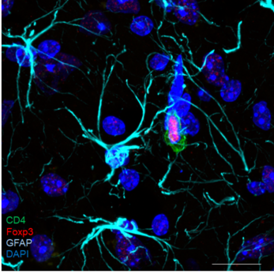
The impact has been enormous, with regulatory T cells going from being a difficult frowned-upon topic of research to one of the most impactful areas of research, studied in every disease setting imaginable. There is a great deal of clinical application of these findings to the fields of autoimmunity and transplantation, where therapeutics that boost these cells in number or function can shut-down even chronic immune reactions. My own lab looks at the brain-resident regulatory T cells (right), which can be used to both slow down neuroinflammation and initiate neurorepair. On the other hand, regulatory T cells are the bad guys in the cancer context, where tumours recruit tumour-resident regulatory T cells to protect against immune rejection. Fortunately, understanding the molecular basis of immune suppression has allowed the design of therapeutics that short-circuit the effect of regulatory T cells, unleashing the latent potential of the immune system. The pre-clinical pipeline is now rich with biologics derived from regulatory T cells, and cell therapies made from genetically-manipulated regulatory T cells, so we can expect many more regulatory T cell-based therapies to enter the market soon!
Congratulations to EVERYONE who contributed to this work!
Final note. In this article I have named the team leaders most influential in the field, but with rare exceptions they were not the people actually doing the research! This progress was hard won by teams of students, technicians and expert scientists who designed and ran the experiments that underpin this discovery. It is their efforts, and the work of those following in their footsteps, that is changing the future for patients!